Memes

  • Memes - Uncategorized

    Beyond the Wall: Football and the Struggle for a Free Palestine

    Share

    PGmeme_freepalestine

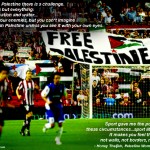
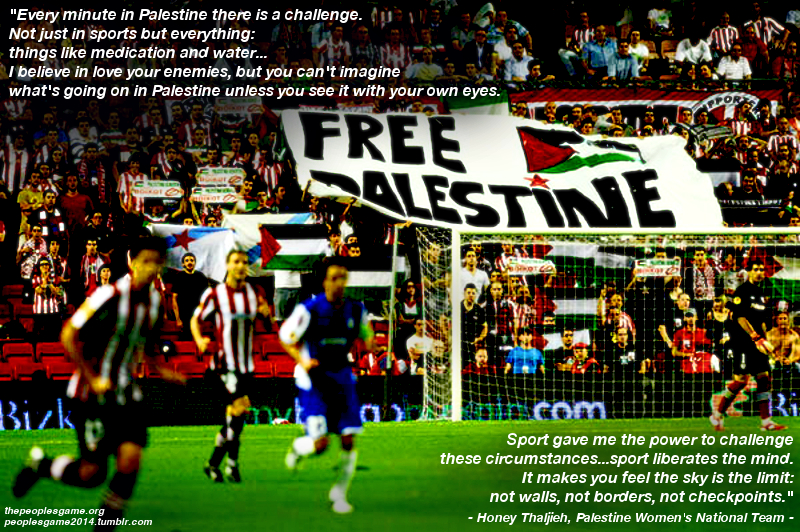
    As the World Cup 2014 knockout rounds progressed, the bombs began to fall in Gaza. The latest Israeli campaign against the Palestinians has, as of this writing, devastated homes, schools, hospitals, and has killed over 800 Palestinians – including four boys playing soccer on the beach.

    Football holds a special significance for the Palestinian people. In an embattled and occupied land with devastated infrastructure, football is a vitally important outlet for youth; as one young footballer put it, “the only hobby Palestinians have left is football.” Like the Algerian team in the 1960s, the Palestinian national team – which is ranked 74th in FIFA standings (its highest ever) and has just qualified for the Asia Cup – is an important representative for Palestinian national identity, humanity, and dignity within the international community; a powerful way of showing the world that the Palestinian people survive and continue to struggle for freedom.

    Perhaps because of this, Israeli forces have especially targeted Palestinian football – kidnapping, imprisoning, killing, and severely injuring players (in two cases, shooting them in the legs), imposing travel restrictions on the national team, and bombing the Palestinian national stadium in 2006 and 2012. Just two weeks ago, nine Palestinian civilians were killed as an Israeli missile targeted a beach where football fans were gathered to watch the World Cup. Since 2010, several international organizations have been documenting the attempts on the part of Israel to destroy Palestinian sport, and have brought grievances to FIFA and UEFA (the European football confederation, of which Israel is a member).

    Mahmoud Sarsak, a player for Palestine’s national team who went on hunger strike while imprisoned in Israel, said that “Israel works endlessly to repress Palestinian football, just like it does many other forms of Palestinian culture…There can be no place in football for segregation and oppression.” Sarsak, like many Palestinian footballers, citizens and their allies, continue to speak out against Israeli occupation and oppression, and stand up for the freedom and dignity of the Palestinian people.

    Solidarity with the people of Gaza! Free Palestine!

  • Memes

    One Way of Saying No: Red Presnia’s Spartak Moscow

    Share

    PGmeme_spartakredsquare

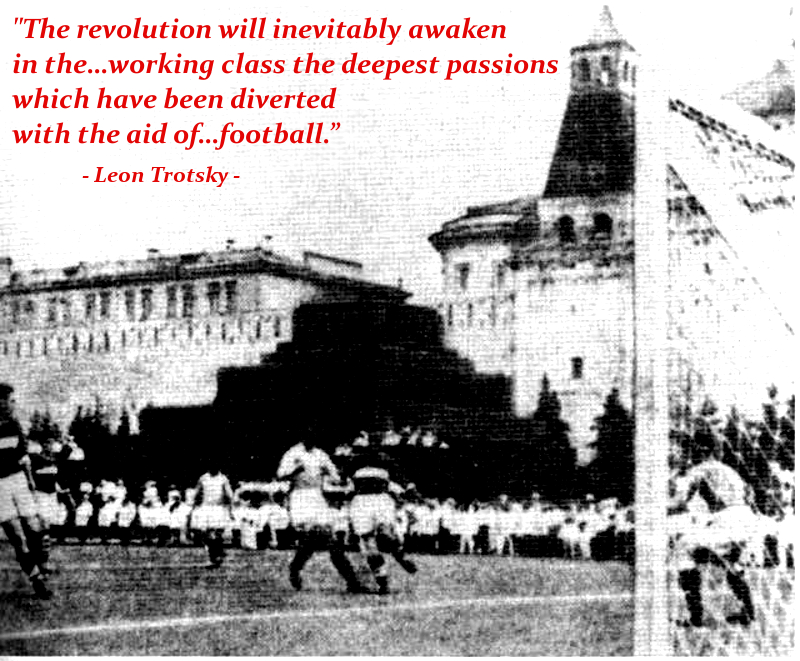
    In 2018, the World Cup’s next stop is in Russia, a country with a great radical tradition, but one with layers of contradictions – many of them embodied by the Spartak Moscow football club.

    As historian Robert Edelman writes: “Spartak Moscow emerged from the rough proletarian Presnia district of Moscow and spent much of its history in fierce rivalry with Dinamo, the team of the secret police. To cheer for Spartak was a small and safe way of saying “no” to the fears and absurdities of high Stalinism; to understand Spartak is to understand how soccer explains Soviet life.”

    This photo depicts Spartak players in a scrimmage in Red Square in 1936, a few years before its stars were purged by the KGB.

    Today, sadly, Spartak’s ‘ultra’ fan groups are associated with far-right nationalist and xenophobic political strands, straying far from the club’s roots in Red Presnia and the 1905 Revolution.

  • Memes

    Left-Wing Football: Cesar Luis Menotti

    Share

    PGmeme_menotti

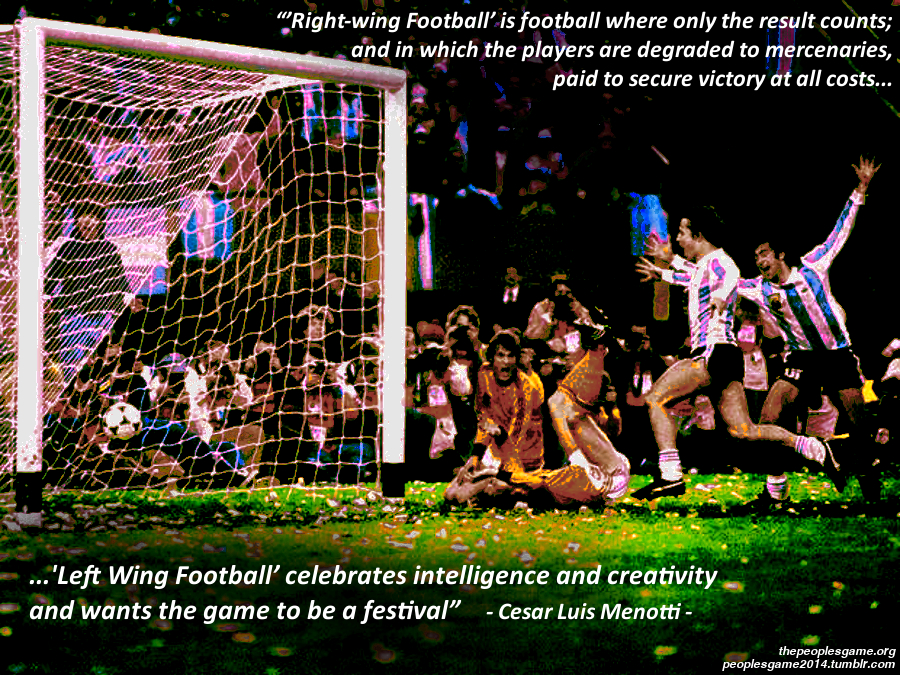
    Despite World Cup Finalist Argentina’s conflicted political history, Argentinian football has always contained strong threads of political radicalism. While other footballers, such as Johan Cruyff, boycotted the 1978 World Cup in Argentina due to the dictatorship, others, like Argentina coach Cesar Luis Menotti, played the games as a point of resistance.

    Argentina won the Cup that year, but Menotti refused to shake the hands of the generals in an act of defiance against the regime. Menotti also coined the term “left-wing football,” noting how politics is inscribed in the very way we play the game.

  • Memes

    FC Bayern Munich and Jewish Resistance to the Third Reich

    Share

    PGmeme_bayern

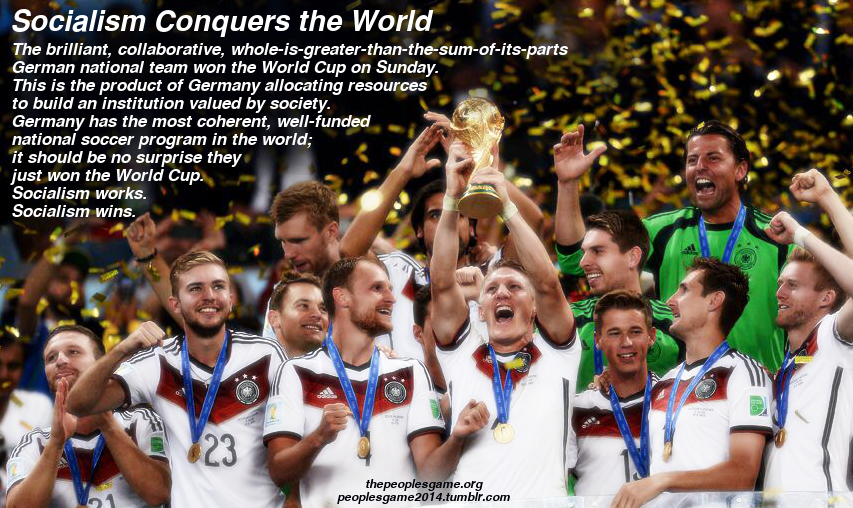
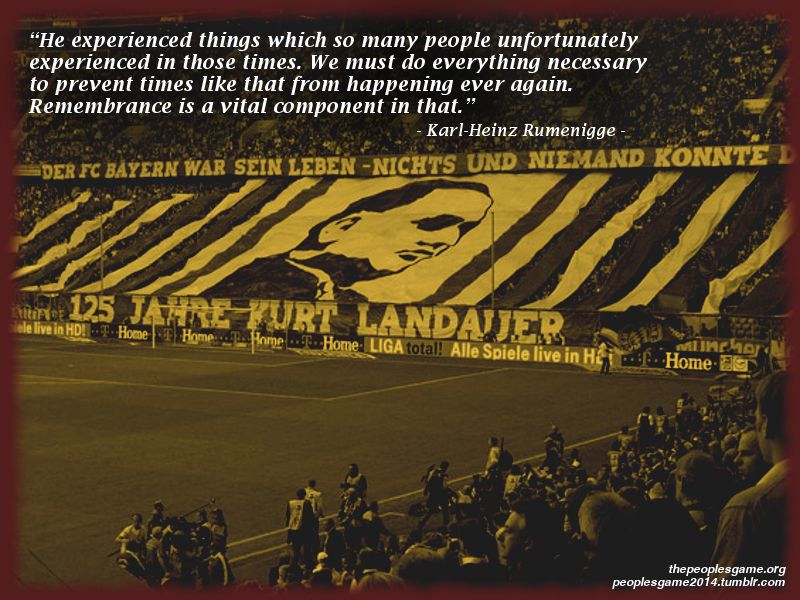
    The core of World Cup Finalist Germany’s superb national team is anchored in the Bundesliga’s champion club, Bayern Munich. This club, which had strong roots in Munich’s Jewish community in the early 20th century, has a rich yet obscure history of resistance to Hitler and the Nazi regime.

    In the 1930s, Bayern’s Jewish president, Kurt Landauer, developed one of the best professional football training systems of its time, and is today known at Bayern as the father of modern German football. He and his players courageously resisted the pressures of the Nazi regime, which denounced Bayern as a “Judenklub,” and won the German championship in 1932. In 1933, however, Landauer was forced to resign as club president, and was later imprisoned for 33 days in Dachau.

    Bayern, however, continued to support Landauer despite the repression; at a match in Zurich, the team saluted Landauer despite being under the heavy watch of the Gestapo. In 2013, FC Bayern Munich officially adopted Landauer as their honorary president, announcing that “Kurt Landauer, south German football pioneer, has returned from exile.”

  • Memes

    Beyond Winning or Losing: Brazil’s Socrates

    Share

    PGmeme_socratesball

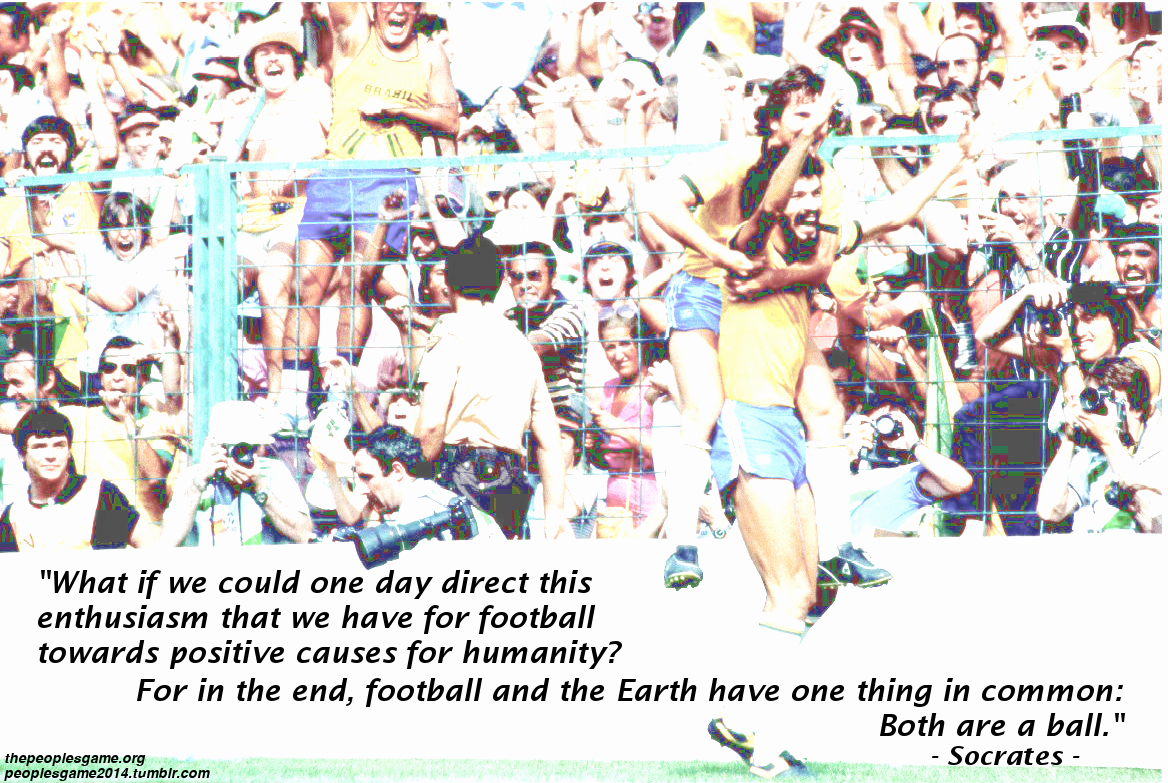
    My greatest wish for the Brazilian team in this unavoidably painful third-place game is that: win or lose, they can focus less on the pressure to win and remember those aspects of soccer – the joy, the teamwork, the fun, the way it brings people together – that make this sport beautiful and subversive; that make it truly the people’s game. The great Brazilian captain Socrates understood this well.

  • Memes

    The Albicelestes and the Abuelas del Plaza de Mayo

    Share

    PGmeme_argentinamadres

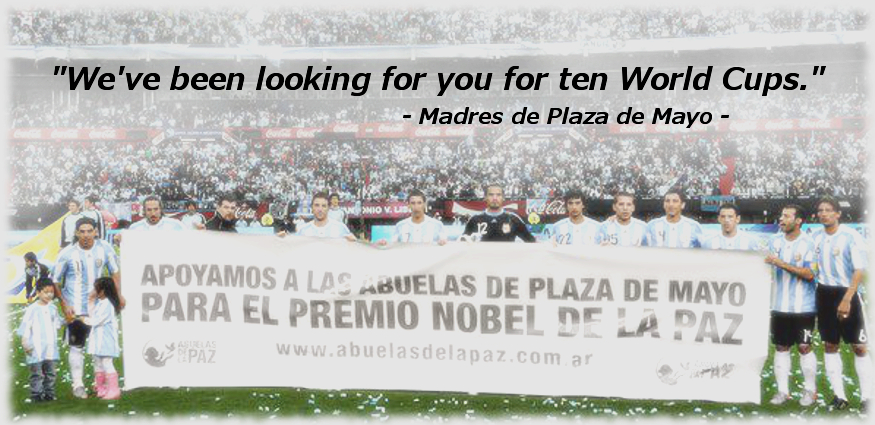
    World Cup Finalist Argentina has a great radical football tradition, despite its conflicted political history. At the 2010 World Cup, the Argentinian national football team declared its support for the Mothers/Grandmothers of the Disappeared (Madres/Abuelas de Plaza de Mayo), an organization of women whose tireless demands for information regarding the 30,000 Argentinians “disappeared” during the military dictatorship represent one of the most powerful forces for truth and social justice in the country today.

  • Memes

    Soccer Against the State: Egypt’s Ultras and the Arab Spring

    Share

    PGmeme_egypt

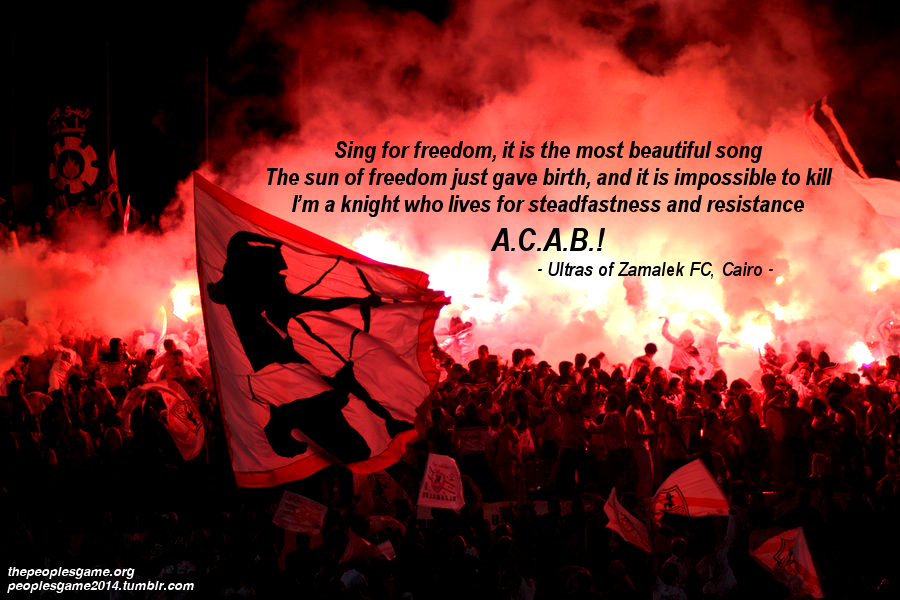
    On this last ‘rest day’ of the World Cup, we pay tribute to another group of revolutionary hooligans: Cairo’s now-legendary Ultras Al-Ahlawy and the White Knights of Zamalek FC. Traditionally bitter rivals, these organized fan groups came together in solidarity at Tahrir Square and were instrumental to the Egyptian Revolution. The ultras embodied resistance to Egypt’s oppressive military regimes, and coined the phrase now echoed around the world by anarchists and forces resisting police violence: “A.C.A.B.” (All Cops are Bastards!)

    After Mubarak’s downfall, they continued to be heavily targeted by counterrevolutionary forces, most infamously in the brutal massacre of 70 ultras after a match in Port Said, Egypt in 2013. In their statement “In Defense of the Ultras,” written after this incident, the Revolutionary Socialists of Egypt had this to say about the politicization and heroism of Egypt’s football revolutionaries:

    “The Ultras [football fans] groups that joined the ranks of the revolution early on, and fought among the revolutionaries proved and are still proving every day that they are an integral part of our revolution. The Ultras originated in Egypt as a reaction to the dominance of the policy of profit and greed of capitalism over football; the turning of soccer into a marketplace of advertising; the rising ticket prices and the monopoly over broadcasting matches as well as the brutality of the security forces.

    Thus arose the Egyptian Ultras groups, like all movements that originated in Egypt in response to tyranny and exploitation. It was no surprise that the Ultras groups found their place in the heart of the Egyptian revolution in search of freedom and justice, and that they have made all the sacrifices incurred by the forces of our militant revolution, rejecting the military council’s looting of the revolution and their re-building a system of oppression and exploitation.

    Long live the Ultras – a fighting faction among the revolutionaries. Glory to the martyrs, victory to the revolution and shame on the criminals.”

  • Memes

    Hooligans Making History: Gezi Park’s Istanbul United

    Share

    PGmeme_istanbulunited

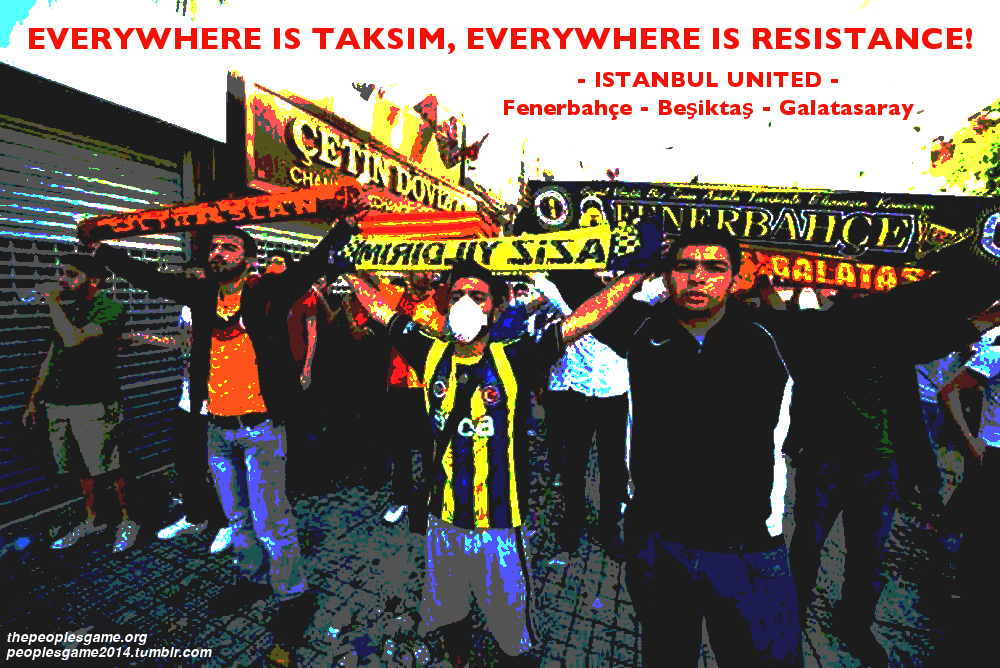
    When protests erupted in Istanbul’s Gezi Park in 2013, the fight for social justice united many sectors of the Turkish people – including, importantly, the notorious “ultras” of Istanbul’s three rival football clubs Beşiktaş, Fenerbahçe, and Galatasaray. Usually feared for their violence towards each other, the ultras came together for the first time in history to support the protests, organized by the politically conscious left-wing ultra group Çarşı to unite for a common cause.

    Gezi Park’s “Istanbul United” is a moving example of how the boundless energy of organized football fandom, combined with conscious political action, can become a powerful force for social justice.