
admin

  • Memes

    Soccer Against the State: Egypt’s Ultras and the Arab Spring

    Share

    PGmeme_egypt

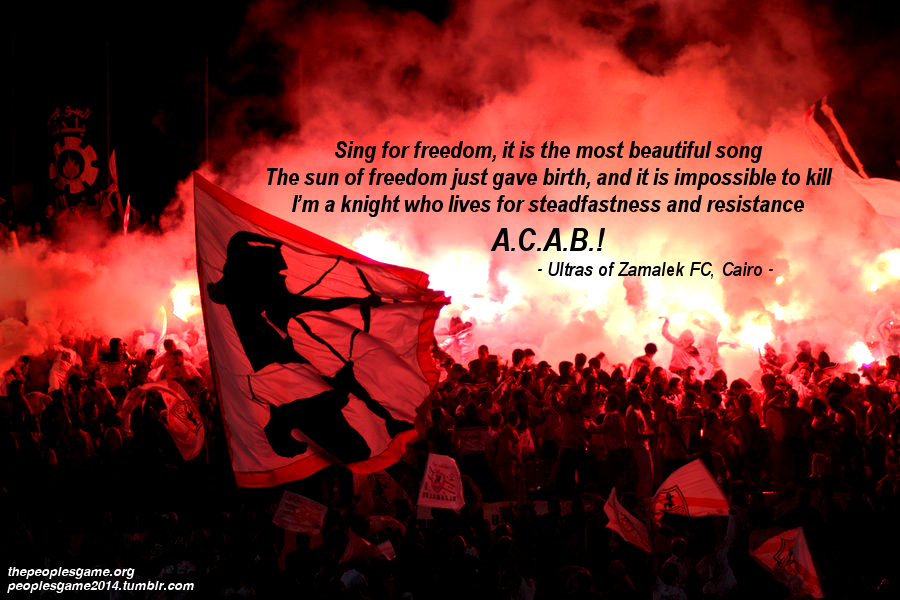
    On this last ‘rest day’ of the World Cup, we pay tribute to another group of revolutionary hooligans: Cairo’s now-legendary Ultras Al-Ahlawy and the White Knights of Zamalek FC. Traditionally bitter rivals, these organized fan groups came together in solidarity at Tahrir Square and were instrumental to the Egyptian Revolution. The ultras embodied resistance to Egypt’s oppressive military regimes, and coined the phrase now echoed around the world by anarchists and forces resisting police violence: “A.C.A.B.” (All Cops are Bastards!)

    After Mubarak’s downfall, they continued to be heavily targeted by counterrevolutionary forces, most infamously in the brutal massacre of 70 ultras after a match in Port Said, Egypt in 2013. In their statement “In Defense of the Ultras,” written after this incident, the Revolutionary Socialists of Egypt had this to say about the politicization and heroism of Egypt’s football revolutionaries:

    “The Ultras [football fans] groups that joined the ranks of the revolution early on, and fought among the revolutionaries proved and are still proving every day that they are an integral part of our revolution. The Ultras originated in Egypt as a reaction to the dominance of the policy of profit and greed of capitalism over football; the turning of soccer into a marketplace of advertising; the rising ticket prices and the monopoly over broadcasting matches as well as the brutality of the security forces.

    Thus arose the Egyptian Ultras groups, like all movements that originated in Egypt in response to tyranny and exploitation. It was no surprise that the Ultras groups found their place in the heart of the Egyptian revolution in search of freedom and justice, and that they have made all the sacrifices incurred by the forces of our militant revolution, rejecting the military council’s looting of the revolution and their re-building a system of oppression and exploitation.

    Long live the Ultras – a fighting faction among the revolutionaries. Glory to the martyrs, victory to the revolution and shame on the criminals.”
  • Radio Show

    The People’s Game Podcast #29 – 7/10/14

    Share

    On today’s podcast, Alan and Meleiza look back on one of the most extraordinary World Cups in recent history, and reflect on the sociopolitical significance of the Cup’s most memorable stories. Then, we feature Alan’s extraordinary interview with Andrei Markovits, one of the world’s leading academics who explores the social impact and significance of sports.

  • Memes

    Hooligans Making History: Gezi Park’s Istanbul United

    Share

    PGmeme_istanbulunited

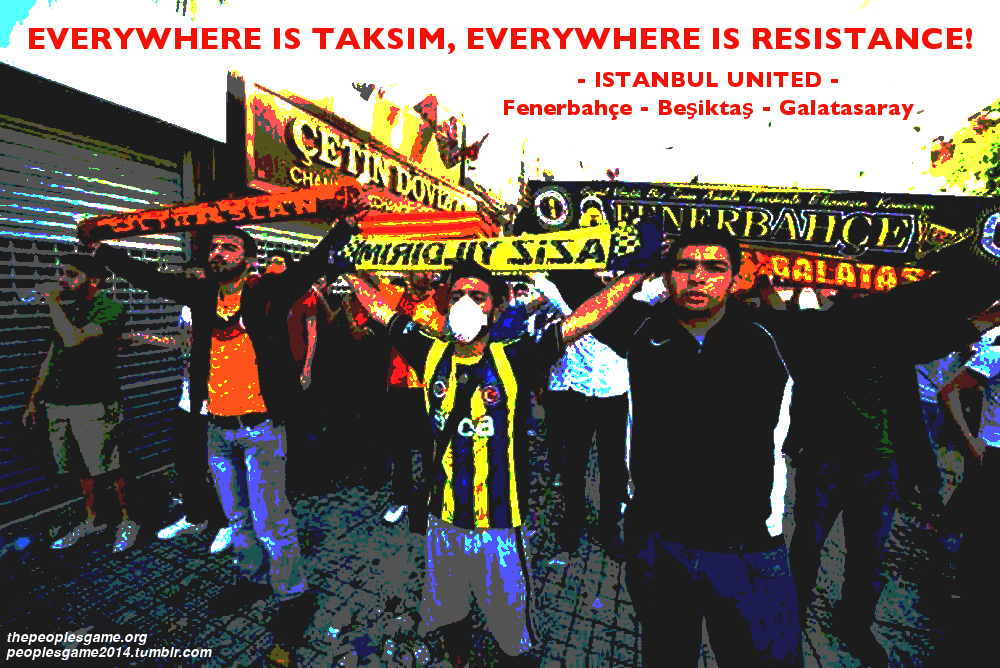
    When protests erupted in Istanbul’s Gezi Park in 2013, the fight for social justice united many sectors of the Turkish people – including, importantly, the notorious “ultras” of Istanbul’s three rival football clubs Beşiktaş, Fenerbahçe, and Galatasaray. Usually feared for their violence towards each other, the ultras came together for the first time in history to support the protests, organized by the politically conscious left-wing ultra group Çarşı to unite for a common cause.

    Gezi Park’s “Istanbul United” is a moving example of how the boundless energy of organized football fandom, combined with conscious political action, can become a powerful force for social justice.

  • Radio Show

    The People’s Game Podcast #28 – 7/9/14

    Share

    So, it’s Argentina and Germany in the World Cup final 2014! Alan and Meleiza review today’s semifinal game, and Argentina’s win in a penalty shootout over the Netherlands. We speak with two members of the Bay Area’s Left Wing FC about futbol, community, and human potential; and Jennifer Doyle reflects on David Luiz’s tears and the triumph of the status quo.

  • Radio Show

    The People’s Game Podcast #27 – 7/8/14

    Share

    On today’s podcast, we talk about one of the most stunning results, perhaps in the entire history of national spectator sports. Alan and Meleiza try to process Brazil’s shocking 1-7 defeat to Germany, on its home soil in Belo Horizonte. Later in the hour, Alan speaks with Pablo Miralles about USA vs Germany and what it’s like to experience soccer in Shanghai, China; and KPFK’s Margaret Prescod continues her conversations with Coach Mickey.

  • Radio Show

    The People’s Game EXTRA – Brazil’s Semi-Final Defeat 7/8/14

    Share

    The world is in shock, and so are we – so much so that we need an extra podcast to make sense of today’s Mineracanazo – a stunning 7-1 defeat of the Brazilian national team, on home soil, in the World Cup semifinal against Germany. In this bonus podcast we feature an extended conversation with Francesco, an activist living in Brasilia, in which we unpack how we got to today’s result, and what the political economy of contemporary global soccer might have to do with it.

  • Radio Show - Today's Radio Show

    The People’s Game Podcast #26 – 7/7/14

    Share

    On today’s podcast, we speak to Teo Ballvé in Bogota, Colombia, who relates the experience of being in a country whose team captured the imagination of the world. Miguel Paredes of the Futbolistas discusses the radical fútbol culture of Southern California, the world’s most ethnically diverse metropolitan area. Alan and Meleiza discuss the political contradictions of Alfredo di Stefano’s brilliant football legacy, and look forward to tomorrow’s Brazil-Germany semifinal.

  • Radio Show - Today's Radio Show

    The People’s Game Podcast #25 – 7/6/14

    Share

    With a couple of days off until the semifinals, Alan and Meleiza mourn the underdogs, but also celebrate the radical traditions of the four soccer powerhouses left standing: Brazil, Argentina, the Netherlands, and Germany. We also speak with Costa Rican/Mexican fan David Orona on Costa Rica’s magisterial performance, and Karen Anzoategui, who watched the Argentina/Belgium quarterfinal live at the Estadio Nacional in Brasília. Finally, we feature our extended conversation with Laurent Dubois on the broader context of the 2014 World Cup.