In this jam-packed podcast, Alan Minsky, Meleiza Figueroa, and Karen Anzoategui begin with Argentina’s debut, the protests at Maracanã Stadium, and a quick recap the day’s action and tomorrow’s games; then Meleiza speaks to a Brazilian activist in the capital city of Brasília; Alan talks with performance artist Karen Anzoategui about her one-woman show, ‘Ser!’, and about growing up a woman soccer fan in the age of Maradona; and Ian Masters speaks with Andrew Jennings, the only reporter banned from FIFA president Sepp Blatter’s press conferences.
-
-
-
-
-
At the top of the show, Alan Minsky and Meleiza Figueroa review the spectacular highs (and lows) of the day’s games. Meleiza then interviews Junior Pisca, who was in attendance at the Spain vs. Netherlands match in Salvador, Brazil; and appears with People’s Game contributor Jennifer Doyle in conversation with KPFK’s Suzi Weissman. Finally, Gustavo Arellano and Alan join host Lalo Alcaraz on KPFK’s Pocho Hour of Power to celebrate the victory of Southern california’s most popular team, El Tri.
-
Great article from People’s Game contributor Jennifer Doyle, who talks about the dilemma faced by people who love the game, but cannot abide by the social injustices done in its name.
The Inevitable World Cup
At this time of year, football fans with a conscience find themselves in a strange situation. We know FIFA is corrupt to the bone; we know that Football Associations are run by imperialist crooks. The people who administer the game are famously sexist, famously racist. We know that they are disgusted by the multitude whose happiness they exploit. At a recent conference on the sport, for example, a FIFA representative responded to a scholar’s paper on the problem of “white elephants” by describing the people to build them as “foolish.” He was obnoxious, but was he wrong? Are we surprised by his attitude, or by the fact that he feels entitled to express such open contempt for the miserable schemers who collaborate with FIFA’s overlords? We know that the FIFA World Cup is awful – and yet we tune in.
Because, of course, The World Cup is a spectacular event. Already, headlines about match fixing and worse have been replaced by headlines about underperformance, cynical play, unfair calls and other staples from football’s story cycle. In its inevitability, in its unavoidable nature we sense something of the World Cup’s ideological power. To call for the end of the World Cup: is that not an attack on happiness itself?
-
-
On today’s podcast, Alan Minsky and Meleiza Figueroa discuss the opening game between Brazil vs. Croatia and the political environment in Brazil; KPFK’s Margaret Prescod speaks to former soccer player Jules Boykoff about this year’s tournament; Pablo Miralles gives us a sense of how the World Cup looks from Shanghai, China and provides insight on this year’s competition; and Truthdig’s Peter Scheer speaks to Al Jazeera’s Khalid Badoun about the World Cup’s opening.
-
The People’s Game is on Truthdig.com! Here is the first of a three-part series written by co-producers Alan Minsky and Meleiza Figueroa on the political stakes of global soccer in 2014.
Part 1: When Soccer Conquered the World looks at global soccer through the prism of history – from its working-class roots to its current neoliberalization.
Stay tuned for Parts 2 and 3!
-
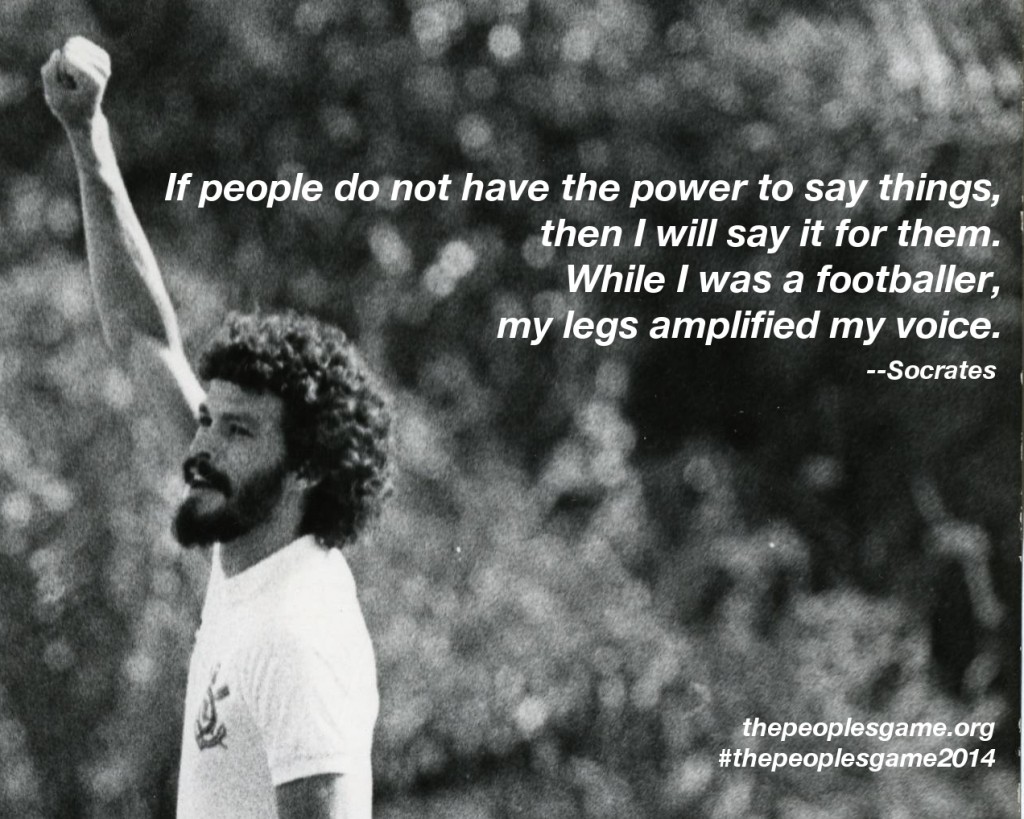
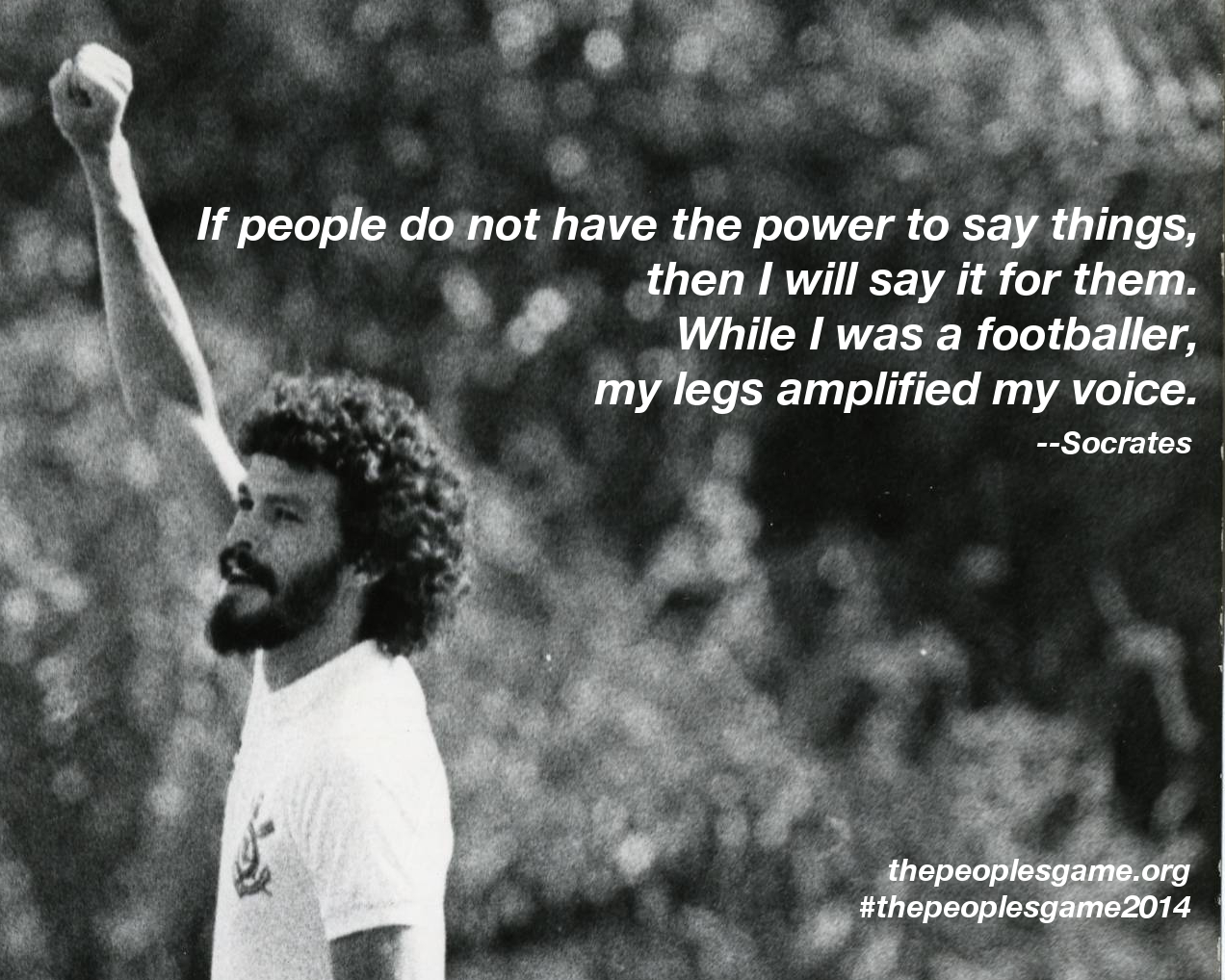
Sócrates was a fierce political thinker and philosopher who used his football stardom on the legendary 1982 Brazilian national team and his home team, São Paulo’s Corinthians, to agitate, educate, and organize the Brazilian people. Against the dictatorship, he turned his own club, Corinthians, into a popular school for democracy.
O Doutor, presente!